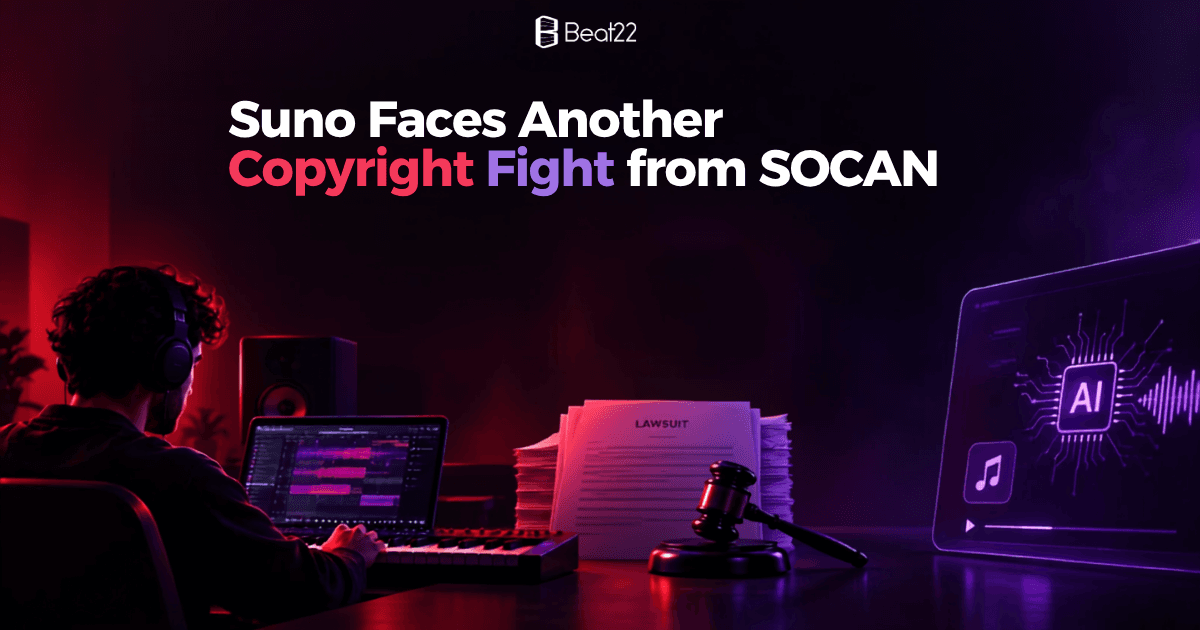
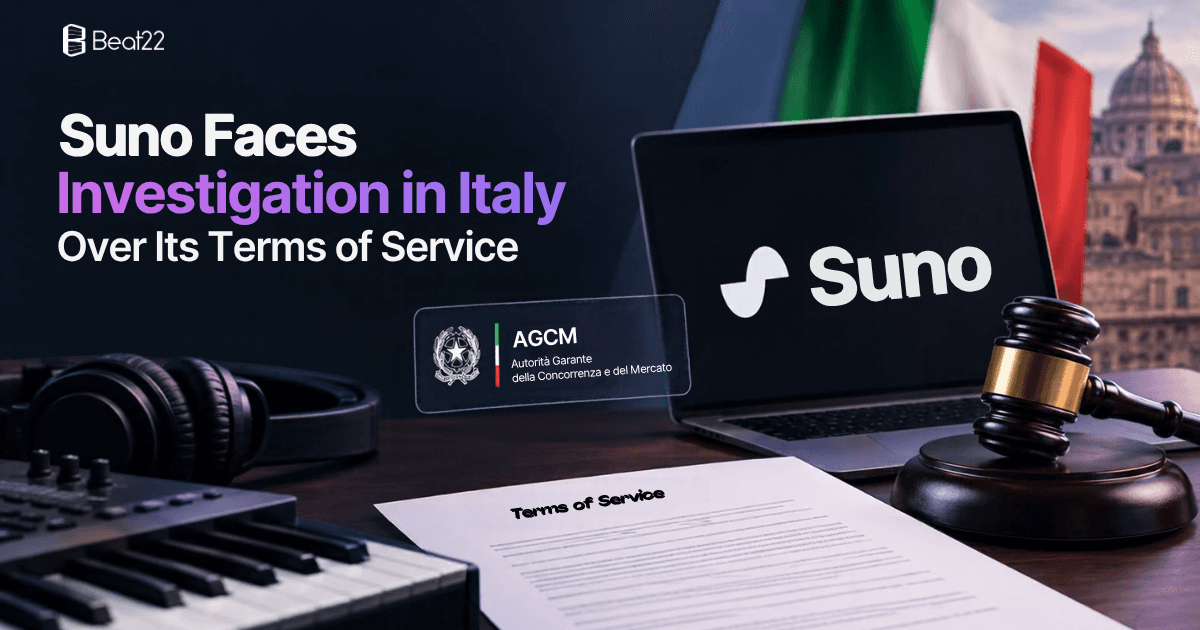
Italy’s competition regulator has opened an investigation into the terms and conditions of Suno, the AI-powered music creation platform, raising important questions about how digital music tools handle creators’ rights, subscriptions, account access and legal disputes.
On October 6, 2026, the Italian Competition Authority, known as the Autorità Garante della Concorrenza e del Mercato (AGCM), announced that it had initiated an investigation into contractual provisions that may be unfair to consumers under Article 33 of Italy’s Consumer Code.
The investigation focuses on several aspects of Suno’s terms, including its ability to change subscription prices and services, terminate user accounts, limit its liability, impose US-based arbitration and require users to waive moral rights connected to their content.
The announcement puts the contractual relationship between AI music platforms and their users under scrutiny, particularly when it comes to ownership, licensing and the rights creators retain when they use these services.
Important: The AGCM’s announcement describes concerns under investigation. It does not establish that every challenged provision is unlawful, nor does it represent a final decision against Suno.
Why has Italy opened an investigation into Suno?
The AGCM’s investigation concerns whether certain clauses in Suno’s Terms of Service could create a significant imbalance between the company’s rights and its customers’ contractual obligations.
According to the regulator, the provisions under examination cover several areas:
- Unilateral changes to the service, contract and subscription prices.
- Suspension or termination of user accounts and associated content.
- Additional contractual conditions that may not be directly accessible before users enter into the agreement.
- Broad limitations on the company’s liability.
- Licensing provisions relating to user content, copyright and moral rights.
- Mandatory individual arbitration in the United States and restrictions on collective legal action.
These concerns fall under Article 33 of Italy’s Consumer Code, which addresses potentially unfair terms in consumer contracts.
The AGCM also announced plans to publish a public consultation on the contractual provisions under investigation. Its announcement identifies eligible trade associations, relevant chambers of commerce and recognized national consumer associations as potential participants.
The investigation therefore concerns the fairness and transparency of the contractual terms offered to consumers, rather than simply whether AI-generated music can be created or commercially distributed.
Copyright and moral rights are at the centre of the investigation
For musicians, producers, songwriters and other creators, the most significant aspect of the investigation may be the licensing language relating to their content.
Suno’s published Terms of Service grant the company a broad license covering content submitted to the platform and content generated through its services. The terms also address the use of voice models and certain rights associated with a user’s likeness and identity.
The AGCM has questioned whether the scope of this license is sufficiently defined and has specifically raised concerns about the requirement that users waive moral rights.
What are moral rights in music?
Moral rights concern an author’s personal relationship with their work. Depending on the applicable law, these can include the right to be recognized as the creator and the right to object to certain distortions or modifications that harm the author’s honour or reputation.
They are distinct from economic copyright, which governs commercial uses such as reproduction, distribution and other forms of exploitation. To understand how music rights are divided in a release, read our guide on publishing rights in music.
Italy’s Law No. 633 of April 22, 1941, sets out protections for authors’ moral rights. Article 20, in particular, addresses the author’s right to claim authorship and to oppose certain harmful modifications to a work.
What does Suno’s wording say?
Suno’s Terms of Service include a provision stating that users irrevocably waive moral rights that may exist in or in connection with their content or voice model.
The AGCM considers this provision particularly important because it believes the license is framed in broad, general terms and raises concerns under Articles 20 and following of Italy’s copyright legislation.
The issue is not merely whether a platform can use content uploaded by its users. It is also whether the scope of that permission is sufficiently clear and whether a contractual waiver of personal rights is compatible with the legal protections applicable to consumers.
The investigation does not, by itself, determine the ultimate enforceability of the provision in every jurisdiction or situation.
Can Suno change subscription prices and services?
Another concern raised by the AGCM involves Suno’s apparent ability to make unilateral changes to its contractual terms, services and subscription prices without specifying a justified reason.
For subscribers, this raises practical questions about the predictability of a paid service.
When musicians subscribe to a music platform, they may make decisions based on its pricing, features, download allowances and available creative tools. Contractual provisions that permit substantial changes without clear conditions can make it difficult for users to understand what they are agreeing to.
The regulator is examining whether the relevant provisions create an unfair imbalance between Suno and its consumers.
This should not be interpreted as a finding that all price changes by subscription services are unlawful. The concern is about the scope and conditions of the discretion provided by the terms under investigation.
Account termination and the risk of losing access to content
The AGCM has also questioned provisions that appear to allow Suno to suspend, disable or terminate accounts, together with associated content, at any time, for any reason and without prior notice.
For creators, account access can be closely connected to their ongoing work.
An account may contain generated tracks, creative experiments, saved versions and other materials associated with a music-making process. Losing access can therefore raise concerns beyond the immediate interruption of a service.
The regulatory question is whether the contractual wording gives the company excessively broad discretion over account termination and the content associated with an account.
This does not mean that Suno cannot enforce platform rules or take action against misuse. Rather, the investigation examines the fairness of the specific contractual provisions governing that discretion.
Musicians using any online creation platform should understand its account policies and avoid treating a platform library as their only record of important creative work.
Broad liability limitations and additional terms
The AGCM has raised concerns about contractual clauses that appear to limit Suno’s liability in broad and general terms, including in relation to personal injury.
It has also questioned provisions that may require consumers to accept additional terms that they cannot directly access before entering into the contract.
These issues relate to transparency and the ability of a consumer to understand the terms of an agreement before accepting it.
For digital services, clear contractual information is important because users need to understand what the provider promises, what responsibilities they retain and what remedies may be available if a dispute occurs.
The regulator will need to assess the provisions through the applicable legal process before reaching a final determination.
Why are US-based arbitration and Massachusetts jurisdiction being questioned?
Suno’s Terms of Service also contain provisions addressing how disputes are resolved.
According to the AGCM, the terms appear to require consumers to pursue claims through binding individual arbitration administered in the United States, subject to restrictive claim deadlines and a waiver of class actions. The regulator has additionally questioned the provision establishing Massachusetts as the exclusive jurisdiction for certain disputes.
For consumers outside the United States, such provisions may raise practical concerns about the cost, complexity and accessibility of seeking a remedy.
The issue being examined is whether these contractual arrangements create an unfair burden on consumers under the applicable consumer-protection rules.
The announcement does not establish that every arbitration clause or foreign-jurisdiction clause is automatically invalid. Its focus is on the specific provisions contained in the terms under investigation.
What do Suno’s current Terms of Service say about content?
Suno announced revised Terms of Service on August 10, 2026, with an effective date of September 3, 2026.
The company also announced changes to its download policy. According to its official announcement, the new limits include:
- Free users: Up to seven lifetime trial downloads for eligible users who joined before September 3, 2026.
- Pro subscribers: 20 downloads per month.
- Premier subscribers: 60 downloads per month.
- Premier users working in Suno Studio: Downloads made through Studio workflows are exempt from the stated download limits.
Suno also states that songs downloaded while a user is subscribed to a paid plan retain commercial-use rights under the applicable terms. Free-plan trial downloads are intended for personal use and are not eligible for commercial use.
These distinctions matter because the right to use a track commercially is not necessarily the same as owning every underlying right, obtaining copyright protection in every jurisdiction or being free from all contractual restrictions.
The company’s terms contain separate provisions concerning content licenses and moral rights. The AGCM’s investigation specifically questions the breadth and definition of those provisions.
Creators should therefore distinguish between commercial-use permissions, copyright ownership, licensing obligations and moral rights rather than treating them as interchangeable concepts.
What does this mean for independent musicians and producers?
The investigation highlights a wider issue for the music industry: the contractual terms governing creative platforms can be as important as the tools those platforms offer.
AI-powered music services can provide musicians with new ways to experiment, develop ideas and create audio. But using these services also involves accepting agreements that may define how submitted material is used, what permissions are granted, how content is handled and how disputes are resolved.
For independent artists and producers, several practical steps are worth considering.
Read the license, not just the pricing page. If you are buying a beat, understand whether an exclusive or non-exclusive license best fits your release plan. Understand what rights you grant when uploading or generating content, including whether the license is perpetual, irrevocable, sublicensable or transferable.
Separate commercial permission from copyright ownership. A license to use music commercially does not automatically mean you own all rights in it. Understand the difference between master rights and publishing rights before releasing. A platform’s permission to use a track commercially does not automatically answer every question about authorship, copyright eligibility or third-party rights.
Understand account and content policies. Check what the terms say about suspension, termination, deletion, storage and continued access to your work.
Keep independent records of important projects. Where permitted by the platform’s terms, retain appropriate copies of important creative materials and project records. Do not assume that continued access to an online library is guaranteed.
Review dispute-resolution provisions. Pay attention to arbitration requirements, governing law, jurisdiction and any deadlines for raising claims.
These are general precautions for users of digital music services. They are not a determination that Suno’s terms are unlawful or that any specific user has lost rights.
What happens next?
The AGCM’s October 6 announcement states that a public consultation on the terms under investigation will be published on the authority’s website in the following weeks.
The consultation is intended for specified trade associations, relevant chambers of commerce and recognised national consumer associations.
The investigation will need to proceed through the applicable regulatory process. The authority’s announcement should therefore be understood as the opening of an inquiry into potentially unfair contractual provisions, not as a final decision on their legality.
Suno’s terms are publicly available, allowing users to review the contractual language directly. Any subsequent changes to those terms, formal submissions or final regulatory findings should be assessed against the relevant official publications.
Readers can monitor the Italian Competition Authority’s official website and Suno’s official Terms of Service for updates.
The bigger picture: AI music needs clear rules for creators
The investigation into Suno raises questions that matter across the evolving music-technology industry.
As AI tools become part of music creation, artists need clarity about how their work is licensed, what rights they retain, how their accounts and content are managed, and what options are available if disagreements arise.
The central issue is not simply whether musicians should use AI tools. It is whether the terms governing those tools are transparent, proportionate and consistent with the legal protections that apply to their users.
For independent musicians and producers, understanding these agreements is an increasingly important part of protecting their creative interests.
Create With Clarity. Release With Confidence.
AI music tools are evolving quickly but knowing who made the music, what rights you receive and how you can use it still matters.
Explore original beats from KYC-verified human producers on Beat22. Find a sound that fits your voice, choose the licence that works for your release, and make your next song with confidence.