The North Carolina case shows how AI can make streaming fraud easier to scale and why legitimate artists, producers and rights holders need to understand how the streaming economy actually works.
Streaming has made music more accessible than ever. For an independent artist, a song can reach listeners across the world without a traditional record deal. For producers, beatmakers and songwriters, digital platforms have created new ways to monetize their work.
But the same infrastructure that makes legitimate music distribution possible can also be manipulated.
In one of the most significant U.S. music-streaming fraud cases involving artificial intelligence, Michael Smith, a 54-year-old man from Cornelius, North Carolina, pleaded guilty in March 2026 to conspiracy to commit wire fraud after using AI-generated music and automated bot accounts to generate billions of artificial streams.
According to the U.S. Department of Justice, Smith ultimately agreed to forfeit $8,091,843.64 after fraudulently obtaining more than $8 million in royalties.
And the case reveals something important about the modern music business:
A stream is only valuable when there is a real listener behind it.
What Exactly Did Michael Smith Do?
The story began long before the guilty plea.
According to the U.S. Department of Justice’s 2024 indictment, Smith allegedly created hundreds of thousands of songs using artificial intelligence and then used automated software or “bots” to repeatedly stream those songs.
The goal was not to build an audience.
It was to create the appearance of one.
Smith reportedly created thousands of accounts on streaming services including Amazon Music, Apple Music, Spotify and YouTube Music. Software was then used to continuously stream music owned by him through those accounts.
The scale was enormous.
The indictment alleged that Smith had estimated his network could generate approximately:
661,440 streams per day
At the time, prosecutors alleged that this level of activity could generate approximately:
$1,207,128 in annual royalties.
But there was another problem.
A single song receiving an extraordinary number of streams would potentially attract attention from streaming platforms and distributors.
So instead of relying on a small number of songs, Smith allegedly needed a huge catalogue.
That is where AI became particularly useful.
AI Wasn’t the Business Model. Scale Was.
One of the most interesting aspects of this case is the role artificial intelligence played.
According to the DOJ, Smith eventually worked with the CEO of an AI music company and a music promoter to produce hundreds of thousands of AI-generated songs.
The songs could then be distributed across a large catalogue and subjected to automated streaming.
The indictment alleges that Smith even created randomly generated artist and song names so that the recordings appeared to come from different artists rather than being obviously connected to a single source.
That distinction matters.
AI-generated music itself is not what made the scheme fraudulent.
The alleged fraud came from using AI to manufacture huge quantities of content and then using bots to manufacture the listening activity around that content.
AI simply made the operation easier to scale.
Instead of needing hundreds of thousands of human musicians to create hundreds of thousands of recordings, an automated system could generate vast quantities of music.
And instead of finding real listeners for those recordings, bots could simulate listening.
The Streaming Numbers Were Fake. The Money Wasn’t.
This is the part that makes streaming fraud fundamentally different from simply uploading music nobody listens to.
Streaming platforms operate within a royalty ecosystem in which legitimate rightsholders receive payments based on usage.
The DOJ explains that royalties are distributed proportionately from a pool of funds. When artificial streams enter that system, money can be diverted toward fraudulent activity instead of legitimate listening.
Think about it this way.
Imagine there is a fixed pool of money being distributed among songs based on legitimate listening.
Artist A gets real listeners.
Artist B gets real listeners.
Artist C gets real listeners.
Now someone introduces millions or billions of artificial plays into the system.
Those plays don’t represent genuine fans discovering music.
But they can still influence the allocation of royalty money.
That is why streaming fraud isn’t simply a case of someone inflating their Spotify numbers.
It can affect the economics of everyone participating in the same ecosystem.
Why Did Smith Need Hundreds of Thousands of Songs?
This is one of the most revealing details in the DOJ’s indictment.
Smith allegedly understood that putting an enormous number of streams on one song could trigger anti-fraud systems.
According to prosecutors, the scheme therefore spread streams across thousands of songs.
The indictment even describes Smith communicating that he needed a huge volume of songs to make the system work around anti-fraud policies.
This created a simple mathematical problem:
More artificial streams → more songs needed → more content needed.
And AI provided a way to dramatically increase the amount of available content.
That is why this case is significant beyond one individual’s alleged conduct.
It demonstrates how generative AI can potentially reduce the cost and time required to produce content at a scale that would previously have been difficult to achieve.
How Much Money Was Actually Involved?
The numbers changed as the case progressed.
When Smith was initially indicted in September 2024, prosecutors alleged that he had fraudulently obtained more than $10 million in royalties.
After pleading guilty in March 2026, Smith agreed to forfeit:
$8,091,843.64
The DOJ stated that he had fraudulently obtained more than $8 million in royalties through the scheme.
He pleaded guilty to one count of conspiracy to commit wire fraud, which carries a maximum statutory sentence of five years in prison. The DOJ explicitly noted that the ultimate sentence would be determined by the judge.
So the important distinction is:
Smith has pleaded guilty and agreed to the forfeiture. That does not mean he automatically received a five-year prison sentence.
Was He Actually Making Music?
Technically, the scheme involved enormous quantities of music.
But the DOJ’s allegations show that the purpose wasn’t to develop artists, build fan communities or create commercially successful records.
The music was essentially being used as inventory for a streaming-manipulation system.
The indictment says the AI company provided thousands of songs per week, eventually producing hundreds of thousands of AI-generated tracks. Smith then used those tracks as the material through which artificial streams could be generated.
This creates an important distinction for today’s creators:
Creating more music is not the same as creating more value.
A producer can make 1,000 beats.
An artist can release 100 songs.
An AI system can generate thousands of tracks.
But without genuine listeners, artistic identity, audience development and legitimate consumption, the number of files in a catalogue doesn’t automatically translate into meaningful music-business value.
And This Problem Is Bigger Than One Person
The Smith case happened in the United States, but streaming fraud is an industry-wide problem.
The International Federation of the Phonographic Industry (IFPI) describes streaming fraud as the manipulation of digital music services to generate revenue from plays that aren’t genuine.
Its 2026 Global Music Report says fraudsters can upload tracks through distributors and use armies of bots to generate artificial plays.
IFPI also says generative AI has the potential to industrialise this process by making mass production of artificial content and artificial listening cheaper and faster.
And the scale of AI-generated content itself is growing rapidly.
According to IFPI’s 2026 report, Deezer reported receiving more than 60,000 fully AI-generated tracks every day in January 2026.
Deezer also reported that up to 85% of streams on AI-generated music were fraudulent in 2025, compared with 70% the previous year.
That statistic needs an important qualification:
It refers specifically to streams on AI-generated music, not to all streams across Deezer or the entire global streaming ecosystem.
But it illustrates why the industry is paying increasing attention to the combination of AI-generated content and streaming manipulation.
AI Music and Streaming Fraud Are Not the Same Thing
This distinction is crucial.
An artist using AI as part of their creative process is not automatically committing streaming fraud.
Similarly, an AI-generated song is not automatically fraudulent.
The issue is how the music is created, represented, distributed and consumed.
For example:
Legitimate use:
A producer uses AI for sound design, experimentation or part of their production workflow, while honestly distributing the resulting work and building an audience.
Fraudulent activity:
Someone creates huge volumes of artificial tracks and then deploys automated accounts to manufacture streams and extract royalty payments.
The Smith case falls into the second category.
The legal problem was not simply:
“He used AI.”
It was the alleged combination of deception + automation + artificial streams + fraudulent royalty extraction.
The Industry Is Now Building Stronger Defences
The response isn’t limited to individual streaming platforms.
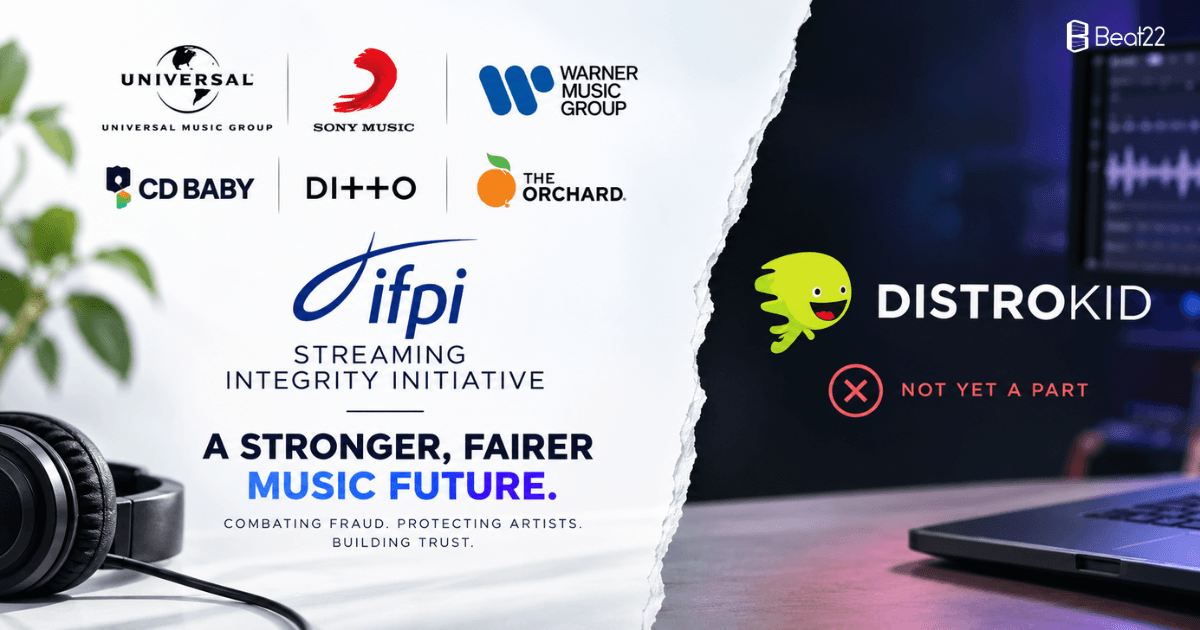
In September 2026, IFPI announced the Streaming Integrity Initiative (SII), bringing together music companies and distributors around baseline practices for preventing and responding to streaming fraud.
The initiative identifies five broad commitments:
- Verify rights ownership and customer identity
- Vet content for fraud, infringement and AI-related risks
- Detect, investigate and mitigate suspected fraud
- Share intelligence where legally permitted
- Continuously improve anti-fraud systems
The significance of this is that the music industry increasingly views streaming fraud as an ecosystem problem.
A distributor may be the entry point.
A streaming platform may host the content.
A rights holder may receive royalties.
And an artist or producer may ultimately be affected by the economics of the system.
So preventing manipulation requires cooperation across those different layers.
What Does This Mean for Independent Artists and Producers?
For independent creators, the lesson isn’t “don’t use AI.”
The bigger lesson is:
Don’t confuse numbers with an audience.
A million streams generated through manipulation don’t represent a million fans.
A legitimate 10,000 streams from people who discovered your music, saved it, shared it, followed you and came back for your next release can be far more meaningful for building a sustainable career.
For producers and beatmakers especially, the long-term asset isn’t simply the number of plays attached to a beat.
It’s the relationship between the producer, the artist, the song and the audience.
That’s why legitimate licensing, clear rights, authentic collaborations and real discovery matter.
What Artists Can Learn From the Michael Smith Case
Don’t buy fake streams.
Artificial streams may make your dashboard look impressive temporarily, but they don’t create genuine fans.
Don’t confuse AI with a shortcut to a career.
AI can accelerate parts of the creative process.
It cannot manufacture an authentic artist identity.
Understand where your royalties come from.
Streaming revenue exists within a larger rights ecosystem involving recordings, compositions, artists, songwriters, publishers, labels and distributors.
Knowing who owns what and who gets paid what is part of being a professional musician.
Keep your music rights and licensing clear.
Whether you’re buying a beat, selling one, collaborating with another artist or releasing a finished song, make sure you understand the licence and rights attached to the music.
Build real listeners.
Real listeners create something bots cannot:
an audience that comes back.
What This Means for Beat22
For Beat22, this case highlights something that has always been fundamental to a healthy music marketplace:
Creators need infrastructure that helps them monetise music legitimately, not shortcuts that manufacture numbers.
Beat marketplaces sit at an important point in the music creation process.
A producer creates a beat.
An artist discovers it.
The artist licenses it.
A song is created.
And that song can eventually reach real listeners.
That entire chain depends on clear licensing, transparent rights and legitimate music creation.
Beat22 is built around that creator-first ecosystem: producers can upload and monetise their beats, while artists can discover beats and license them for their music.
Because ultimately, the sustainable music economy isn’t built on fake streams.
It’s built on real producers, real artists, real songs and real listeners.
And the Michael Smith case is a powerful reminder of what happens when technology is used to manufacture the appearance of all four.