Streaming fraud has become one of the biggest challenges in the music industry. From fake streams and AI-generated uploads to identity fraud and copyright infringement, digital streaming platforms are under increasing pressure to protect artists’ royalties and maintain trust.
To address this, the International Federation of the Phonographic Industry (IFPI) launched the Streaming Integrity Initiative (SII) in September 2026, a global framework for distributors to help combat streaming fraud before music even reaches streaming platforms.
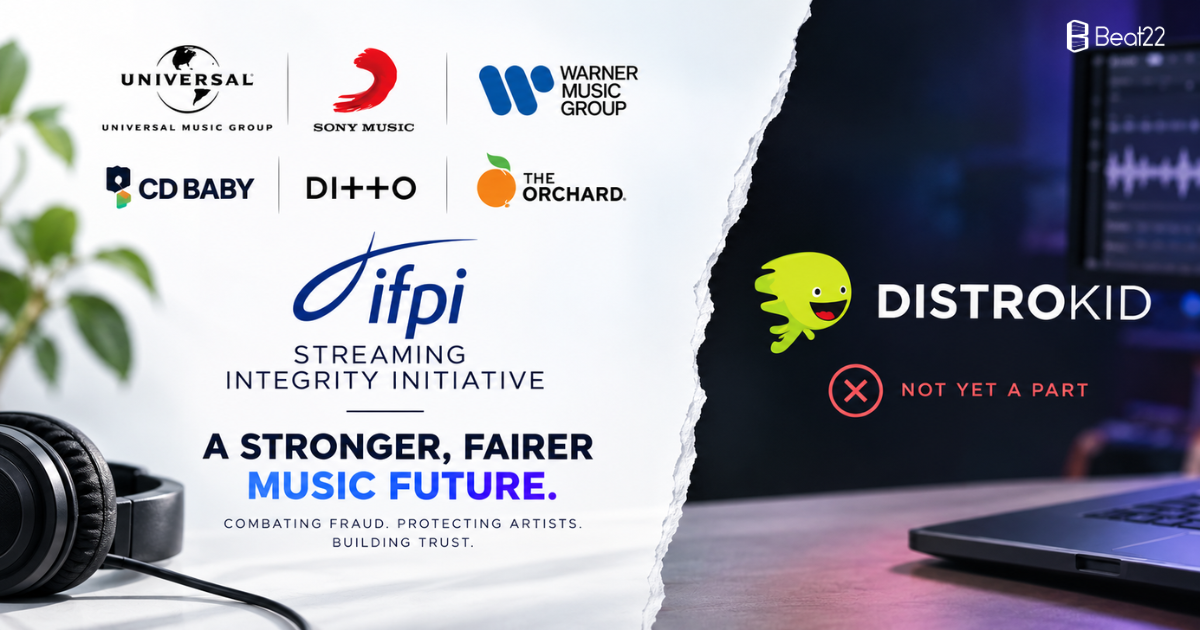
While many of the world’s biggest music companies and distributors have signed on, one notable name is missing: DistroKid.
Here’s what the initiative is, who has joined, why DistroKid’s absence is getting attention, and what it means for independent artists.
What is the IFPI Streaming Integrity Initiative?
The Streaming Integrity Initiative (SII) is a voluntary set of anti-fraud principles created by IFPI, the organization representing the global recorded music industry.
The goal is simple: stop fraudulent music uploads before they reach Spotify, Apple Music, YouTube Music, Deezer, Amazon Music, and other streaming services.
According to IFPI, distributors adopting the initiative agree to strengthen systems that identify fraudulent activity, verify users, and collaborate with the wider music industry against bad actors.
The five core principles
Principle & What it means
1. Identity verification – Use Know Your Customer (KYC) and rights verification to confirm who owns the music and who is uploading it.
2. Content vetting – Screen uploads for copyright infringement, suspicious activity, AI-related risks, and fraudulent content.
3. Fraud detection and enforcement – Investigate suspicious uploads, remove fraudulent content, and take action against repeat offenders.
4. Industry intelligence sharing – Share fraud-related information with other industry participants where legally permitted.
5. Continuous improvement – Regularly strengthen fraud detection systems as new threats evolve.
IFPI describes these as baseline expectations for distributors that want to strengthen streaming integrity.
“Streaming fraud misleads fans and deprives legitimate artists and songwriters of income that should rightfully flow to them. This is theft, plain and simple.” – Victoria Oakley, CEO, IFPI.
Source: IFPI Streaming Integrity Initiative.
Who has signed the initiative?
The first wave includes 24 organizations across labels, distributors, and industry associations.
Major music companies
* Universal Music Group
* Sony Music Group
* Warner Music Group
* HYBE
* Merlin
Distribution companies
* CD Baby
* AWAL
* The Orchard
* Virgin Music Group
* FUGA
* ADA
* Ditto Music
* RouteNote
* Symphonic Distribution
* Secretly Distribution
* IDOL
* Absolute Label Services
* Too Lost
* GoDigital
* CmdShft
* Revelator
* InnerCat Music Group
Industry associations
* IMPALA
* Merlin
* Additional regional organizations participating with IFPI.
These companies publicly committed to supporting the initiative’s anti-fraud principles.
The biggest name missing: DistroKid
DistroKid has not signed the Streaming Integrity Initiative as of IFPI’s announcement.
Why is this significant?
Because DistroKid says it distributes:
* More than 45 million songs
* Music for over 4 million artists
* Roughly 40% of all new music uploaded globally
That makes it one of the largest music distributors in the world.
Its absence doesn’t necessarily mean it opposes anti-fraud efforts. It simply means it has not publicly adopted IFPI’s new framework yet.
Other major distributors that have also not signed so far include:
* TuneCore
* Believe
* UnitedMasters
Why CD Baby signing is important
One interesting development is CD Baby joining the initiative.
CD Baby serves millions of independent artists who self-release music, similar to DistroKid’s business model.
Following Universal Music Group’s acquisition of Downtown Music Holdings in 2026, CD Baby became part of Universal’s broader distribution ecosystem and is now among IFPI’s listed participants.
This shows that DIY distribution platforms can participate alongside major-label-owned distributors.
Why is streaming fraud such a big problem?
Streaming fraud isn’t just fake Spotify plays.
It includes multiple types of abuse affecting artists, platforms, and royalty pools.
Common forms of streaming fraud
Type & Examples
Artificial streaming – Bots generating fake plays to inflate royalties.
Identity fraud – Someone uploads music using another artist’s identity.
Copyright infringement – Uploading music without owning the rights.
AI-generated spam uploads – Thousands of AI-created tracks uploaded to earn streaming revenue.
Metadata manipulation – Using misleading artist names or song metadata.
Fraud doesn’t just affect platforms, it reduces royalty pools available to legitimate artists.
The AI music upload problem
AI-generated music is growing faster than the industry’s moderation systems.
Deezer’s latest numbers
Deezer announced that it was receiving around 90,000 fully AI-generated tracks every day during June 2026.
The company also said AI music represented more than half of all new uploads arriving on its platform.
That volume makes automated detection increasingly important.
Why distributors matter
Distributors act as the gateway between artists and streaming services.
If fraudulent uploads are detected before reaching Spotify or Deezer, platforms have fewer fake releases to manage.
That’s exactly what IFPI wants distributors to improve.
Suno, AI music, and DistroKid
The debate became louder after industry analysis showed a strong connection between AI music uploads and distribution services.
According to SIQA’s Q1 AI music analysis:
* Over 90% of tracks submitted to its AI music charts were created with Suno.
* A significant majority of those tracks were distributed through DistroKid.
This doesn’t mean DistroKid created or endorsed the content.
It reflects where creators chose to distribute AI-generated music.
Suno’s response
Suno later introduced download limits for subscribers, saying the change was designed to make mass exporting of AI-generated music more difficult and reduce abuse by bad actors.
What does “voluntary” actually mean?
This is an important detail.
The Streaming Integrity Initiative is not a law.
It is voluntary.
The published framework currently includes:
* No mandatory audit.
* No reporting requirement.
* No penalties for non-compliance.
* No enforcement mechanism from IFPI.
Signing the initiative is a public commitment rather than a certification program.
That means companies can support it voluntarily, and companies that haven’t signed are not automatically considered non-compliant.
Does DistroKid already have anti-fraud measures?
Yes.
This is an important piece of context often missed in discussions online.
DistroKid is a founding member of the Music Fights Fraud Alliance, launched in 2023.
The alliance includes music companies, distributors, and streaming services working together against streaming manipulation.
DistroKid also maintains policies against:
* Artificial streaming.
* Copyright infringement.
* Fraudulent royalty activity.
* Repeat policy violations.
So the discussion isn’t about whether DistroKid has anti-fraud policies, it is about whether it has joined IFPI’s new industry-wide framework.
What this means for independent artists
If you’re releasing music independently, this announcement matters for several reasons.
1. Expect stronger identity verification
More distributors are likely to require additional KYC information.
That could include:
* Government ID.
* Business verification.
* Tax information.
* Rights ownership documentation.
2. Copyright checks may become stricter
Uploads using uncleared samples, duplicate recordings, or misleading metadata may face additional review.
3. AI-generated music may face additional scrutiny
Platforms and distributors are building systems to distinguish:
* Human-created music.
* AI-assisted music.
* Fully AI-generated music.
* Potential spam uploads.
4. Fraud investigations may happen faster
Repeat offenders could lose distribution access across multiple services if companies begin sharing fraud intelligence where legally permitted.
What artists should do before uploading music
A simple checklist for legitimate independent releases:
- Upload only music you own or have licensed.
- Keep documentation for collaborators, producers, and samples.
- Use accurate artist names and metadata.
- Avoid buying streams, playlist bots, or fake promotion services.
- Complete identity verification when your distributor requests it.
These practices reduce the risk of takedowns or delayed releases.
Why this matters beyond one distributor
The Streaming Integrity Initiative reflects a broader shift happening across the music industry.
Streaming platforms, labels, distributors, and trade organizations are increasingly treating streaming fraud as an ecosystem-wide problem rather than a platform-specific issue.
For independent artists, that likely means:
* More verification.
* Better fraud detection.
* Greater scrutiny of suspicious uploads.
* More protection for legitimate royalties if enforcement improves.
Whether additional distributors including DistroKid, TuneCore, Believe, or UnitedMasters, join the initiative remains to be seen.
For now, the initiative marks one of IFPI’s clearest public efforts to create shared anti-fraud standards across the global music distribution industry.
Official sources
This article is based on information published directly by official industry organizations and companies.
* IFPI — Streaming Integrity Initiative announcement and official SII principles.
* IFPI — Statement from CEO Victoria Oakley.
* Merlin — Official statement supporting the Streaming Integrity Initiative.
* IMPALA — Official statement on industry collaboration and streaming integrity.
* Deezer — Official announcement on AI-generated music upload volumes.
* Suno — Official announcement introducing download limits to reduce abuse.
* DistroKid — Official July 2026 company announcement describing its artist count, catalog size, and claim of distributing roughly 40% of new music uploads globally.