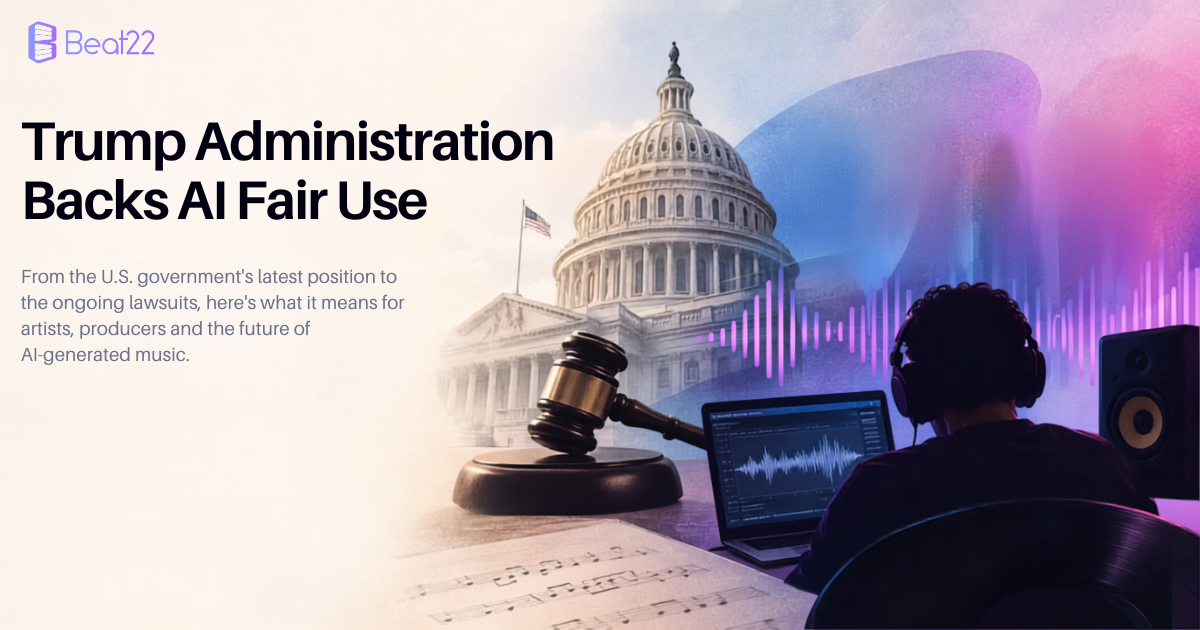
The U.S. government has taken a significant position in the AI copyright debate, arguing that AI companies can use copyrighted material to train their models without a license in certain circumstances. While the government’s latest filing concerns written works, its reasoning could have major implications for the music industry’s ongoing copyright battles with AI music companies including Suno and Udio.
Artificial intelligence has created a new fault line in the music industry: Can an AI company copy millions of copyrighted recordings to train a music-generation model without first obtaining permission from the rights holders?
That question is at the heart of the copyright lawsuits brought by major music companies against AI music platforms Suno and Udio.
In June 2024, the Recording Industry Association of America (RIAA), together with major record companies, filed separate lawsuits against Suno and Udio alleging that the companies had copied copyrighted sound recordings on a massive scale to train their AI systems. The record companies argued that the unauthorized copying of their recordings was copyright infringement.
Suno and Udio have argued that their use of copyrighted music for training is protected by the fair-use doctrine under U.S. copyright law.
Now, a new development in Washington has brought that argument back into the spotlight.
What did the Trump administration actually say?
On September 1, 2026, the U.S. Department of Justice filed a Statement of Interest in the copyright litigation between The New York Times and OpenAI.
The government argued that using copyrighted works to train AI models can, in appropriate circumstances, qualify as fair use.
The DOJ’s position is based on the argument that training an AI model is a transformative technological use rather than simply distributing or republishing the original copyrighted material. The government also argued that overly restrictive copyright rules could hinder technological innovation and U.S. competitiveness.
But there is an important distinction:
The filing is about copyrighted text, not music.
It does not decide the Suno or Udio lawsuits.
It does not establish that training an AI music model on copyrighted recordings is automatically fair use.
And it does not mean that Suno or Udio have won their copyright cases.
Instead, it gives the AI industry’s fair-use argument a significant boost because the U.S. government has now explicitly argued that AI training can qualify as fair use in at least some circumstances.
That is why the music industry is paying attention.
Why Suno and Udio are at the centre of the music debate
Suno and Udio are generative AI music platforms capable of creating songs from user instructions.
The controversy isn’t simply about the music they generate.
The bigger legal question is:
What music was used to teach these systems?
In its 2024 complaint against Suno, the RIAA alleged that Suno copied copyrighted sound recordings “en masse” and ingested them into its AI model.
The complaint against Udio similarly alleges that copyrighted recordings were copied and used to train its AI model.
The record companies argued that this wasn’t comparable to a human musician listening to music and learning from it.
Their argument was that AI companies were making digital copies of copyrighted recordings at enormous scale and using those copies as inputs for commercial AI systems.
That distinction is central to the lawsuit.
Suno’s defence: fair use
Suno has argued that using copyrighted music to train its model is protected by fair use.
The company has argued that its system does not simply reproduce the recordings it was trained on. Instead, the training process allows the model to learn musical patterns and generate new works.
That puts the case directly into one of the most difficult areas of modern copyright law:
When does learning from copyrighted material become copying?
Humans have always learned from music.
A producer listens to thousands of records.
A guitarist studies other guitarists.
A songwriter absorbs different genres and influences.
But an AI system can process enormous quantities of recordings automatically and at a scale that no human could realistically replicate.
The copyright question is therefore not simply whether an AI system “learns” from music.
It is whether the technical process used to make that learning possible including copying and storing copyrighted recordings is itself protected by an exception such as fair use.
Fair use is not a blanket permission to use copyrighted music
This is where the debate becomes important for musicians.
Under U.S. copyright law, fair use is not an unlimited right to use someone else’s copyrighted work.
The law considers several factors, including:
* the purpose and character of the use
* the nature of the copyrighted work
* the amount of the work used
* the effect of the use on the potential market for the original work
The U.S. Copyright Office has specifically been studying how these principles apply to generative AI and copyrighted training material. Its AI initiative examines questions surrounding the use of copyrighted works in AI training and the legal status of AI-generated outputs.
That means the question isn’t simply:
“Was copyrighted music used?”
It is:
“Under these particular circumstances, was that use legally fair?”
And that remains a major unresolved question in the U.S. music industry.
Why the government’s position matters to music
The DOJ’s filing doesn’t settle the Suno and Udio lawsuits.
But its reasoning could become important.
If courts accept the government’s broader argument that AI training is sufficiently transformative to qualify as fair use, AI companies could have a stronger legal argument when defending their use of copyrighted works.
That could significantly change the economics of AI music.
Imagine two possible futures.
Future 1: Licensing becomes mandatory
AI companies would need permission from rights holders before using copyrighted music to train their systems.
That could create a new licensing market involving:
record labels → publishers → artists → songwriters → AI companies
AI companies could pay for access to catalogues, with revenue flowing back to rights holders.
Future 2: Training is broadly protected by fair use
AI companies could potentially train models using much larger quantities of copyrighted music without obtaining traditional licenses, depending on how courts ultimately interpret the law.
That could dramatically lower the cost of building AI music models.
And it would raise a difficult question:
If human-made music is the raw material that makes these systems valuable, should the people who created that music participate in the value generated by the technology?
The music industry’s argument is about more than ownership
For record companies and artists, this isn’t simply about stopping AI.
The music industry has increasingly been arguing for a framework where AI innovation can continue while creators retain control over their rights and receive appropriate compensation.
The RIAA’s lawsuits against Suno and Udio were described as cases for “responsible AI,” reflecting the industry’s argument that AI development should respect existing copyright protections.
The U.S. Copyright Office has also recognised that generative AI raises significant copyright policy questions requiring careful consideration rather than a simple yes-or-no answer.
This is an important distinction.
The debate isn’t necessarily:
Music industry vs AI.
It is increasingly:
Unlicensed AI vs licensed, transparent AI.
And the industry is already moving toward licensing
The legal battles are happening alongside another major development: AI companies and music companies are beginning to explore licensing relationships.
That matters because it demonstrates that there is another possible path forward.
Instead of:
Copy → train → monetize → fight over copyright
the industry could move toward:
License → train → create → compensate.
That model would allow AI companies to access high-quality music while giving rights holders a defined commercial relationship with the technology.
The outcome of the Suno and Udio litigation could influence how attractive and necessary such licensing models become.
What this means for independent musicians
This debate isn’t only relevant to Universal Music Group, Sony Music or Warner Music.
It could eventually affect every musician who owns original music.
An independent producer might have hundreds of original beats.
A songwriter might have decades of compositions.
An artist might own recordings that are available across streaming platforms.
Those catalogues represent intellectual property.
If AI becomes increasingly dependent on large quantities of human-created music, the question of how that music can be accessed and used becomes increasingly important.
For musicians, the future could therefore involve much more than simply uploading music and collecting streaming royalties.
It could involve decisions around:
* AI training
* licensing
* attribution
* metadata
* provenance
* opt-in and opt-out systems
* commercial usage
* AI-generated derivatives
* rights management
From Beat22’s perspective: rights need to remain visible
At Beat22, we work with original music and the people who create it.
That makes this debate particularly relevant to us.
The more technology develops, the more important it becomes for musicians and artists to know what they are buying, who owns it and what they are allowed to do with it.
This is one of the reasons licensing infrastructure matters.
A beat isn’t simply an audio file.
Behind that file is a rights relationship between a producer and an artist.
When an artist licenses a beat, they need clarity around the permitted use of that music.
The same principle should apply to AI.
Technology should make music creation easier not make music rights harder to understand.
The bigger question: who owns the value created by AI?
The Suno and Udio cases could eventually become some of the most important copyright disputes in modern music.
Because the underlying question goes far beyond two AI companies.
It asks:
If an AI system learns from millions of human-made songs, who should benefit from the economic value created by that learning?
The answer could shape the next generation of music technology.
If courts ultimately decide that this type of training is protected by fair use, AI companies could have considerably more freedom to build models using copyrighted music.
If courts decide that copying music for training requires permission, a massive new licensing market could emerge.
And there could ultimately be a middle ground where certain forms of training are permitted while commercial AI systems are required to license particular categories of music.
For now, the law remains unsettled.
What happens next?
The Trump administration’s intervention makes the fair-use debate even more significant.
But it is important not to confuse a government legal position with a court ruling.
The DOJ has supported the proposition that AI training can qualify as fair use in the OpenAI litigation.
The Suno and Udio cases are separate.
Their courts will have to consider the facts surrounding music, sound recordings, training practices, copying and potential market effects.
And those decisions could have enormous consequences for musicians and the companies building the next generation of music technology.
The future of AI music may depend on one word: permission
AI music isn’t going away.
The technology will continue improving.
The question is what the relationship between AI and human-made music will look like.
Will AI companies build models from licensed catalogues?
Will courts allow broad fair-use protections?
Will musicians receive compensation when their music contributes to AI systems?
Will artists be able to control how their recordings are used?
And will listeners know whether the music they’re hearing was created by a human, generated by AI or made through a combination of both?
Those questions are still being answered.
But one thing is becoming increasingly clear:
The future of music AI won’t be determined only by how good the technology becomes. It will also be determined by how the industry handles the rights behind the music that teaches it.
For Beat22, that’s a future worth paying attention to because as music discovery, creation and licensing become increasingly technology-driven, the value of original human-made music should remain visible in the system.